Kill The Shadow Deduction Corkboard Guide
Connect clues, resolve contradictions, and build case theories Lucas can defend in court—or on the street.
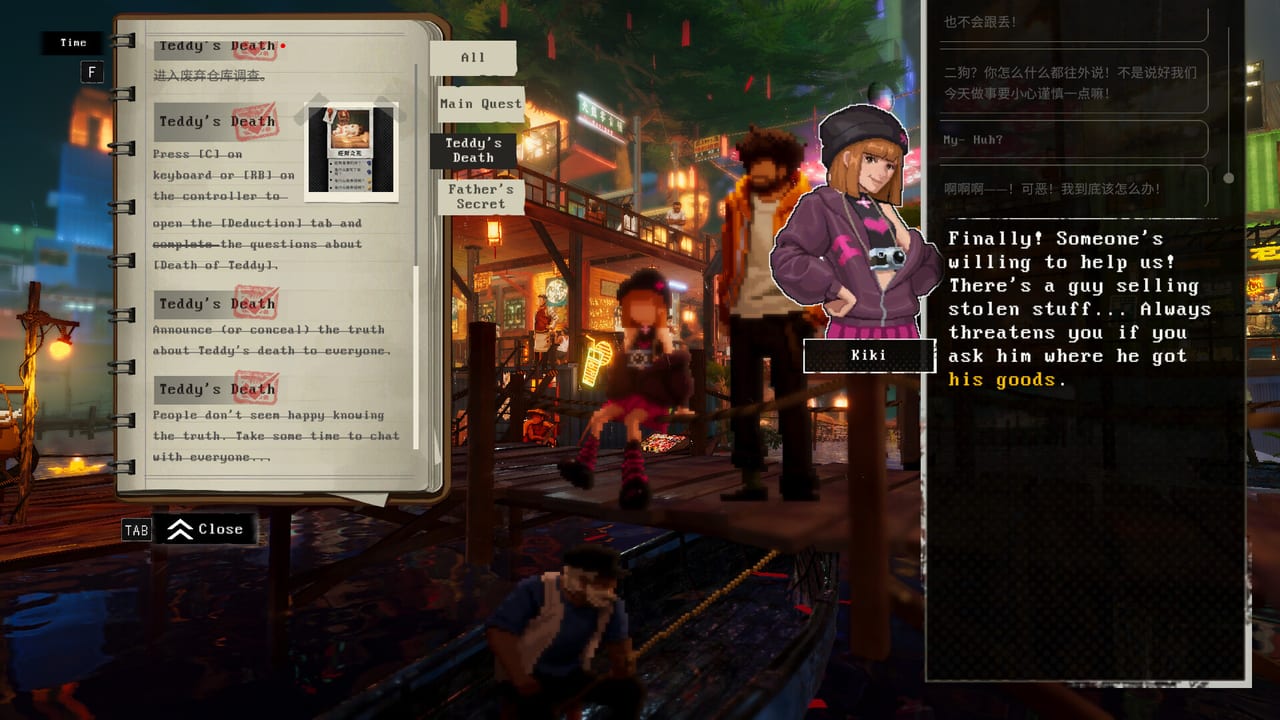
The corkboard is Kill The Shadow’s nerve center. Shadowlight’s cyber-noir detective RPG does not hand you a single golden path through each case; it asks you to justify why Teddy died, why Master Reed vanished at a temple fair, or why Shipwreck Wharf grudges end in blood. Lucas pins testimony, objects, Rewind observations, and location notes to a physical board, then draws connections until a story holds together under scrutiny.
If you treat the corkboard as optional decoration, cases stall. If you treat it as a logic puzzle with narrative teeth, Dark Tide City opens up. This guide explains how deduction works, how Rewind feeds the board, and the controller tip that prevents hours of frustration: use the D-pad, not the analog stick, when moving and linking cards.
What the corkboard represents
Narratively, the corkboard is Lucas thinking in public—messy, revisable, and honest about gaps. Mechanically, it is a graph: nodes are clues, people, locations, and hypotheses; edges are claims you assert between them.
Typical node types include:
- People — Captain Theo, Axel Flint, Rafe Carter, Kiki, Mrs. Reed, the Priestess, Auntie Bass, Chiffon, and suspects tied to active cases.
- Places — Shipwreck Wharf, Pig Cage Walled City, Old Town, the shuttered factory, and specific rooms inside them.
- Objects — Weapons, tokens, dog collars, fair tickets, shipping manifests, anything inspectable in the world.
- Statements — Paraphrased dialogue lines flagged during interrogation.
- Rewind fragments — Time-stamped observations from The Shadow’s reconstructions.
You are not rewarded for hoarding nodes. You are rewarded for valid links that explain motive, means, and opportunity—or that break an alibi with precision.
Building a board from zero to accusation
Step 1: Collect without judging
Early exploration should flood the board with raw facts. Talk to wharf workers about grudges, interview Mrs. Reed about Master Reed’s habits, ask Captain Theo about Teddy’s routes. Each new card is cheap; deletion is free. The mistake is premature pruning—throw away a Priestess quote too early and Spirit-gated revisit lines never activate.
Step 2: Cluster by case thread
Kill The Shadow often runs parallel threads. Visually group cards by case—Teddy, Master Reed, wharf feud—even if they later connect. Cross-case links happen in full playthroughs when politics overlap; the demo may keep threads cleaner, but the habit scales.
Step 3: Link with labeled relationships
When you connect two cards, choose relationship types carefully: witnessed, owned, contradicts, supports, last seen at. Vague linking weakens accusations. If Rafe Carter contradicts Axel Flint on ship arrival times, that edge should pop when you confront either man.
Step 4: Identify contradictions deliberately
Contradictions are features, not bugs. Spirit-heavy interrogations often exist to turn contradictions into confessions. Mark conflicting statements, then decide which side lacks Rewind support. The Shadow’s reconstructions are treated as strong evidence—use them to break lies without guessing.
Step 5: Hypothesis nodes before accusations
Insert explicit hypothesis cards: “Teddy poisoned near wharf,” “Master Reed taken during fair ritual.” Hypotheses focus exploration. Delete or revise them when disproven; keeping ghost theories clutters dialogue prompts.
Step 6: Accuse with a defended chain
Final accusations should trace a readable path on the board. Controllers and judges—in fiction and gameplay—react poorly to leaps. If you accuse a dock boss, show motive (grudge), means (tool or poison), and opportunity (Rewind timestamp).
Rewind and the corkboard
Rewind supplies cards you cannot earn any other way. After reconstructing a victim’s last moments, new nodes appear—positions, overheard phrases, hidden objects mid-scene. Always return to the corkboard immediately post-Rewind while memory is fresh.
Some players Rewind first and talk second; others clear dialogue trees before Rewind to maximize Spirit options. Both orders work if you revisit the board between steps. Details live in Rewind and The Shadow Explained; the short version is: Rewind proves geometry and timing, interrogation proves intent.
Controller and input tips
On gamepad, corkboard precision matters. Analog sticks drift and overshoot card slots; the D-pad snaps cleanly between pins and link handles. This is official controller guidance worth treating as mandatory:
- Move selection with D-pad — Not the left stick.
- Confirm links with face buttons — After highlighting both endpoints.
- Zoom or pan if available — Use stick only for camera, not card selection.
Keyboard and mouse players still benefit from deliberate linking—mis-clicks create false edges that poison Spirit confrontations. See Controls for full binding maps.
Case examples without spoiling every beat
Teddy and Captain Theo
Theo’s dog Teddy anchors an emotional case with investigative teeth. Expect cards tied to walking routes, last meal sources, and who had access near Old Town or wharf edges. Animal cases test whether you chase obvious suspects or follow trace evidence.
Master Reed and the temple fair
Mrs. Reed’s panic feeds Spirit and Charm branches. Fair schedules, Priestess rituals, and Old Town crowd movement produce timeline cards. Contradictions often involve who saw Master Reed last—not whether he attended.
Shipwreck Wharf grudges
Dock politics generate dense social graphs. Axel Flint’s lineage to Griff Flint matters; Rafe Carter may know street truth versus official logs. Strength opens dock intimidation; Charm buys manifest access from clerks who fear both bosses and police.
Walkthrough steps for each case live in the Walkthrough hub; this guide stays system-focused.
Common mistakes
- Linking without labels — Creates ambiguous graphs that fail accusation checks.
- Ignoring revisit dialogue — New edges unlock after Rewind or bribery.
- Single-thread obsession — Miss cross-district clues hiding in Pig Cage Walled City while stuck at the wharf.
- Analog stick card control on gamepad — Produces mislinks; switch to D-pad.
- Accusation before hypothesis testing — Soft-locks story branches toward bad endings.
Integrating attributes and endings
Strength, Spirit, and Charm do not replace the corkboard—they feed it. Locked dialogue yields missing nodes; missing nodes block links. Multiple endings track which hypotheses you believed, who you protected, and whether your graph matched ground truth. A sloppy board can “win” a fight and still land a tragic ending because you framed an convenient lie.
Plan attribute spreads with the Builds hub; track ending requirements with Tools. For broader detective flow, read How to Play Kill The Shadow. Demo players should pair this page with Demo Getting Started before exporting habits into the full Steam release.
Quick reference checklist
- Collect every dialogue and inspectable before deleting cards.
- Rewind after major scene discoveries; board immediately.
- Label every edge; hunt contradictions for Spirit routes.
- Use D-pad on controller for card work.
- Form hypotheses explicitly; revise ruthlessly.
- Accuse only when motive, means, and opportunity link.
The corkboard is where Kill The Shadow stops being a walking simulator and becomes a detective RPG. Treat it with the same respect Lucas gives a crime scene tape line.
Frequently Asked Questions
Quick answers to the most common Kill The Shadow questions.
Why should I use the D-pad on the corkboard?
The analog stick drifts and overshoots card slots on controller, causing mislinks. The D-pad snaps selection cleanly between cards and link points, which is the intended precision input for corkboard work.
What belongs on the Kill The Shadow corkboard?
People, places, objects, dialogue statements, Rewind observations, and explicit hypothesis nodes. Valid labeled links between them form case theories you can defend during accusations.
Can I solve cases without using Rewind?
Rewind provides timing and spatial evidence you cannot obtain elsewhere. Skipping it leaves gaps that block Spirit confrontations and weakens corkboard chains needed for stronger endings.
How do contradictions help investigations?
Conflicting statements become labeled edges between cards. Spirit interrogations leverage contradictions—especially when Rewind proves one side false—to force confessions or new leads.
Does a full corkboard guarantee the best ending?
No. You can build coherent but wrong theories. Endings reflect whether your final accusation matches truth and how you treated suspects and witnesses across Strength, Spirit, and Charm choices.