How to Play Kill The Shadow
Attributes, interrogation, exploration, and the detective loop in Dark Tide City.
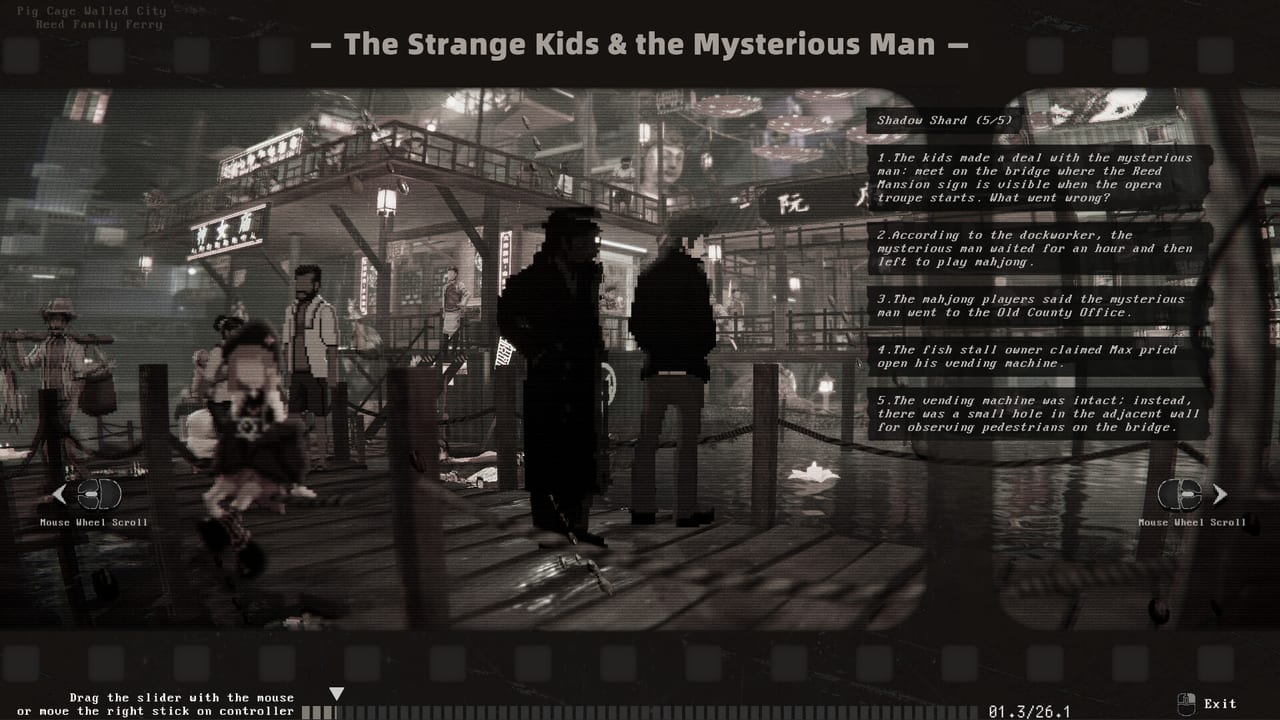
Kill The Shadow is a cyber-noir detective RPG developed by Shadowlight and published by Phoenix Game. You step into the worn shoes of Lucas, a former police detective who left—or was pushed from—the official force and now solves cases the department will not touch. Dark Tide City is not a friendly backdrop; it is a network of districts, grudges, and secrets that only unravel when you combine street-level investigation with supernatural insight from The Shadow on Lucas’s back.
This guide explains the core gameplay loop: explore, talk, Rewind when the dead have more to say, build theories on the corkboard, and confront suspects with evidence you can defend. If you are jumping in through the free Steam demo, the same fundamentals apply—the demo is a slice of the full experience, not a simplified tutorial mode.
The detective loop in practice
Every case in Kill The Shadow follows a rhythm that rewards patience over rushing to accusations.
- Pick up a case thread — Captain Theo might mention Teddy, his dog, found dead under suspicious circumstances. Mrs. Reed might beg you to find Master Reed after he vanished during a temple fair. Dockworkers at Shipwreck Wharf whisper about old grudges that end in bodies.
- Explore districts — Travel between locations such as the shuttered factory, Shipwreck Wharf, Pig Cage Walled City, and Old Town. Scenes hide inspectable objects, overheard dialogue, and environmental storytelling in 2.5D pixel art—3D spaces rendered with 2D character sprites that keep noir mood readable at a glance.
- Interrogate witnesses and suspects — Dialogue branches depend on your attributes and prior discoveries. Missing a line today often means returning tomorrow with a new clue.
- Use Rewind when appropriate — The Shadow lets Lucas reconstruct final moments of the dead. Rewind scenes add sensory details—positions, timings, hidden objects—that flesh-and-blood witnesses forgot or lied about. See Rewind and The Shadow Explained for system depth.
- Build theories on the corkboard — Connect people, places, motives, and objects until a coherent story emerges. The Deduction Corkboard Guide covers linking rules and controller tips.
- Accuse or intervene with proof — Multiple endings track whether you blamed the right party, protected the vulnerable, or let politics win.
Skipping steps feels faster until a corkboard gap blocks progress entirely. The game expects you to oscillate between exploration and synthesis.
Attributes: Strength, Spirit, and Charm
Lucas grows through three attributes that gate interrogation options. Think of them as how you apply pressure—not whether you are allowed to investigate.
Strength
Strength represents physical intimidation and forceful presence. High Strength unlocks dialogue where Lucas slams a table, blocks an exit, or makes it clear that cooperation is cheaper than a hospital visit. Use Strength on hardened dockworkers at Shipwreck Wharf or suspects who respect only dominance hierarchies. It is not mindless violence—Kill The Shadow frames force as a detective tool with social consequences. Captain Theo may notice if you bully witnesses who trusted the badge you used to wear.
Spirit
Spirit covers psychological pressure: reading micro-expressions, calling out contradictions, and pushing guilt without throwing a punch. Spirit shines during interviews with nervous family members—Mrs. Reed after Master Reed’s disappearance—or religious figures like the Priestess when ritual details matter. Spirit options often appear after you collect conflicting statements, so revisit NPCs once the corkboard highlights a lie.
Charm
Charm opens persuasion, empathy, and bribery routes. Informants like Kiki in Pig Cage Walled City may trade rumors for cash or favors. Charm can also de-escalate scenes where Strength would burn a long-term contact. Some players underinvest in Charm because bribery costs money, but skipping it locks off entire confession paths tied to Auntie Bass, Chiffon, and other socially connected NPCs.
Balance matters across a full playthrough. A Strength-heavy Lucas solves dock cases fast but may miss Spirit-gated confessions in Old Town. A Charm-focused run buys information yet struggles against suspects who laugh at polite questions. The Builds hub explores focused attribute plans; this guide recommends keeping all three viable early so demo cases teach the full toolkit.
Interrogation and dialogue strategy
Interrogation is not a single Q&A screen—it is a web of timed opportunities across districts.
- Revisit NPCs after Rewind — Rewind often reveals names or objects NPCs react to only when asked precisely.
- Cross-check family and gang ties — Axel Flint’s identity as Griff Flint’s son opens different lines than Rafe Carter’s street-level perspective. The Characters hub helps track relationships.
- Note locked options — Greyed-out choices show missing attribute ranks or absent clues. Farm side observations rather than guessing.
- Avoid orphan accusations — The corkboard should support any formal accusation. If you cannot draw links between motive, means, and opportunity, keep investigating.
Choices ripple into multiple endings. Saving a sympathetic suspect for later testimony might prevent a wharf bloodbath; framing the wrong dock boss could close Shipwreck Wharf vendors permanently.
Exploring Dark Tide City
Districts differ in density and danger.
Shuttered factory — Industrial decay hides evidence from corporate cover-ups and old labor disputes. Inspect machinery logs and broken locks.
Shipwreck Wharf — Salt, neon, and grudges. Long-feuding crews tie into cases that look like accidents until Rewind proves otherwise.
Pig Cage Walled City — Tight alleys and layered communities. Informants here respond to Charm and consistent respect.
Old Town — Temple fairs, traditional rituals, and disappearances like Master Reed’s. Spirit and cultural sensitivity matter.
Use the Map hub for travel connections and fast-reference landmarks. Pair exploration with Controls if you play on controller—movement and interaction bindings stay separate from corkboard D-pad rules.
Presentation and platform notes
Kill The Shadow ships on Steam (app 2660230) with a free demo (app 2947640). Languages include English, Simplified Chinese, Traditional Chinese, Japanese, Korean, and Italian. Minimum PC requirements sit at Windows 10, Intel i5-6400 or Ryzen 5 1400, 8 GB RAM, GTX 1060 or RX 580, DirectX 11, and about 4 GB storage. Recommended specs—Windows 11, i5-12600K or Ryzen 5 7600X, 16 GB RAM, RTX 3060 or RX 6600XT, DirectX 12—help in crowded district hubs and Rewind sequences.
Recommended reading order
After this page, continue to Deduction Corkboard before your first major synthesis session, then Rewind and The Shadow for supernatural scene literacy. Demo players should finish with Demo Getting Started. Case-specific beats live in the Walkthrough hub; opinion and performance notes sit in Review. For quick checklists, bookmark Tools.
Frequently Asked Questions
Quick answers to the most common Kill The Shadow questions.
What are the three attributes in Kill The Shadow?
Strength gates forceful interrogation, Spirit unlocks psychological pressure and guilt reads, and Charm enables persuasion, empathy, and bribery. All three shape which dialogue options appear during investigations.
Who is Lucas in Kill The Shadow?
Lucas is the player character, a former police detective operating outside official channels in Dark Tide City. The Shadow rides on his back and grants the Rewind ability used to reconstruct victims' final moments.
Do I need to complete the corkboard before accusing someone?
Practically, yes. The corkboard connects clues into defensible theories. Accusations without linked motive, means, and opportunity tend to fail or push you toward worse endings.
Which districts should I explore first?
Early cases pull you through Old Town, Shipwreck Wharf, and Pig Cage Walled City depending on the active thread. Return to the shuttered factory when industrial clues surface in dialogue or Rewind scenes.
Is the demo representative of full-game mechanics?
Yes. The free Steam demo uses the same attribute, interrogation, Rewind, and corkboard systems as the full release, making it a strong training ground before launch.
Where can I find controller tips for investigation?
Movement and interaction bindings are listed in the Controls hub. For corkboard card placement, use the D-pad instead of the analog stick—details are in the Deduction Corkboard guide.