Kill The Shadow The Shadow
Lucas's supernatural partner—and the source of Rewind across Dark Tide City.
The Shadow is the defining supernatural presence in Kill The Shadow, the cyber-noir detective RPG from Shadowlight, published by Phoenix Game for Steam in August 2026. Visible on Lucas’s back throughout Dark Tide City, it is neither pet nor passive skill icon. The Shadow speaks, judges, and—most critically—grants Rewind: the ability to reconstruct and replay the final moments of the dead so Lucas can spot details ordinary forensics miss.
Players who treat The Shadow as a lore accessory lose cases. Players who treat it as an omniscient oracle also lose cases. The entity sits between those extremes: a partner with its own perspective on truth, guilt, and what Lucas is willing to see.
What The Shadow is—and is not
The Shadow is bound to Lucas after his departure from formal police work. Official backstory keeps portions deliberately ambiguous—enough to fuel speculation across Old Town temple rumours and Pig Cage street gossip, not enough to hand players a single canonical explanation before the campaign unfolds. What is mechanically clear: The Shadow enables Rewind scenes, feeds the deduction corkboard with reconstructed fragments, and occasionally comments on Lucas’s choices during interrogations.
The Shadow is not a replacement for witness interviews, physical evidence, or logical corkboard links. Captain Theo and other grounded NPCs still expect Lucas to justify accusations with human-readable proof. Rewind might show who held a knife; it will not automatically convince Mrs. Reed or Axel Flint to confess on its own.
Rewind system in practice
Rewind triggers at narrative checkpoints—typically when Lucas discovers a body or critical death-linked clue—and transports him into a stylised replay of the victim’s last moments. Environmental details matter: door positions, overheard phrases, off-screen movements, and timing that contradicts witness testimony. Each observation can become a corkboard card once the scene ends.
The demo’s Rewind system received a significant revamp after Steam Next Fest feedback, smoothing transitions and clarifying which details are collectible versus atmospheric. Outlets like TheGamer highlighted the demo as a festival favourite partly because investigation felt tactile rather than scripted. For patch-level notes and first-run tips, read Demo Review and Rewind and The Shadow Explained.
Controller players should separate Rewind navigation from corkboard placement: community guides on Controller controls emphasise using the D-pad—not the analog stick—when linking evidence on the board after Rewind sessions.
The Shadow and the deduction corkboard
Kill The Shadow’s corkboard is where Rewind output becomes actionable theory. Fragments from reconstructed scenes often pair with testimony from Rafe Carter, Kiki’s photographs, or Auntie Bass’s market rumours. The Shadow may highlight emotional beats during Rewind—fear, hesitation, betrayal—but Lucas must still drag cards, draw connections, and resolve contradictions manually.
See Deduction Corkboard Guide for connection rules and contradiction handling. Spirit-heavy builds sometimes unlock additional dialogue when reviewing Rewind notes with witnesses, while Strength-heavy Lucas may intimidate suspects into confirming what The Shadow already showed.
Personality and narrative tension
The Shadow is written as a character with opinions, not a silent ability bar. It pushes Lucas toward uncomfortable conclusions—sometimes aligning with Captain Theo’s institutional caution, sometimes cutting against it. That tension mirrors Lucas’s own split from the police: official truth versus street truth versus supernatural truth.
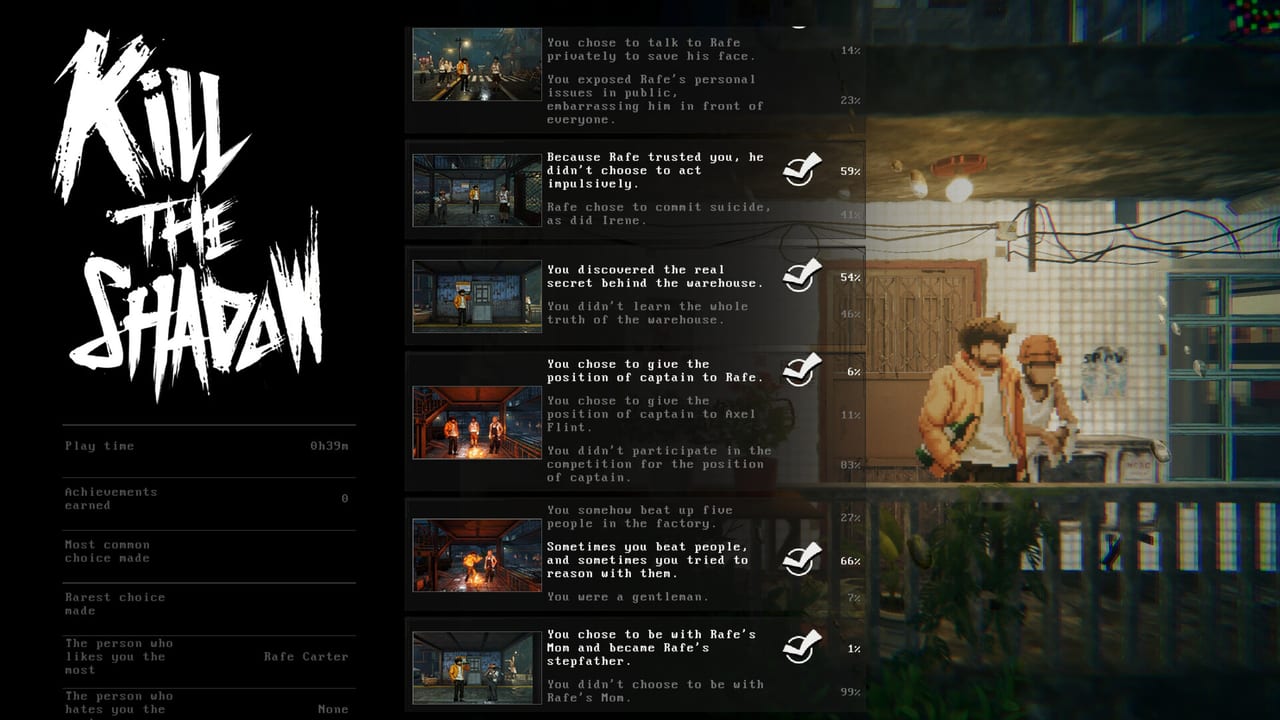
Multiple endings in Kill The Shadow reflect how consistently Lucas follows The Shadow’s nudges versus his own moral compass. Walkthrough and Builds pages document branching flags; this profile avoids spoiling specific late-game reveals while flagging that ignoring The Shadow entirely is its own path with consequences.
The Shadow across districts
Rewind scenes inherit art direction from each district:
- Shuttered factory — Industrial silhouettes, machinery noise, and union-era grudges frozen in final seconds.
- Shipwreck Wharf — Mud, stilt creaking, and smuggling-adjacent deaths where Axel Flint’s circle often appears.
- Pig Cage Walled City — Neon glare, cramped alleys, and gang politics readable in body language.
- Old Town — Fair crowds, temple incense, and disappearances tied to Mrs. Reed and the Priestess’s circles.
District familiarity speeds Rewind parsing. Use Map of Dark Tide City and Districts guide so layout knowledge from exploration carries into reconstructed scenes.
Related characters and systems
- Lucas — Bearer of The Shadow; attribute builds change how you act on Rewind discoveries.
- Key NPCs — Witnesses who confirm or deny what Rewind suggests.
- How to Play — Full investigation loop from crime scene to accusation.
- Tools — Build Planner — Spirit-focused builds often synergise with post-Rewind interrogations.
- Review hub — Release trailer context and broader impressions of Kill The Shadow’s art and systems.
Playing with The Shadow effectively
- Run Rewind immediately when unlocked, but take notes before rushing to confront suspects.
- Cross-check every Rewind detail against at least one human source when possible—Kiki’s photos, dock records, Priestess schedules.
- Update the corkboard before accusations; The Shadow shows moments, not legal verdicts.
- Revisit districts after Rewind; new dialogue often appears once Lucas knows specific timing or positions.
- If demo Rewind feels different from clips you saw online, trust the current build—Next Fest revamps intentionally changed pacing and clarity.
The Shadow makes Kill The Shadow more than a dialogue tree with a noir filter. It is the reason Lucas can compete with Dark Tide City’s lies—and the reason he can never pretend this job is purely human again.
Frequently Asked Questions
Quick answers to the most common Kill The Shadow questions.
What does The Shadow do in Kill The Shadow?
The Shadow enables Rewind—replaying victims' final moments—and supplies supernatural perspective during investigations. It also feeds corkboard clues Lucas must still connect and justify.
Was Rewind changed in the demo after Next Fest?
Yes. Developers revamped the demo Rewind system following Steam Next Fest feedback, improving clarity and flow. Demo Review covers player impressions including TheGamer's praise.
Can Lucas remove or ignore The Shadow?
The Shadow is narratively bound to Lucas. You can choose how much to trust its pushes during cases, and those choices contribute to branching endings.
Does The Shadow replace normal detective work?
No. Witness testimony, district exploration, and corkboard deductions remain mandatory. Rewind adds detail; it does not auto-solve cases for Captain Theo or other authorities.
Where can I watch official Shadow footage?
The official release date trailer on this page shows Lucas and The Shadow in action. Demo Review links Next Fest footage for pre-launch gameplay.